

A purity figure on a gas cylinder label is one of the cheapest claims in the industry to make — and one of the hardest to prove. “99.999%” takes three seconds to print. Verifying it takes four deliberate steps, and buyers who skip them tend to find out in the field, not in the lab, when a process that passed on the first lot starts misbehaving on the third.
Here’s the verification process we walk new export customers through before their first order. It works the same whether the supplier is a global major or a specialist plant in Wuhan.
- Ask for a per-lot certificate of analysis (CoA) that lists O₂, H₂O, N₂, CO and hydrocarbons separately. “Guaranteed 99.999%” is a promise, not data.
- Match the grade to what your process actually tolerates. Most industrial work runs fine on 4N; electronic and laser work usually needs 5N as a floor.
- Audit the lab behind the number: which GC, which detection limits, which calibration standards.
- Put per-lot impurity limits in the contract. Averages don’t protect you; limits do.
What the “N” numbers actually buy you
The notation is simple even if the production behind it isn’t: 4N means 99.99%, 5N means 99.999%, 6N means 99.9999%. Each added “N” knocks out 90% of whatever impurity was left, which means the last digits come from genuinely different hardware — purification trains, passivated cylinders, dedicated fill lines. A supplier who runs 5N noble gases has different equipment on the floor than one who ships 4N bulk. That’s why “just a bit purer” undersells what’s actually changing.
And the headline number is half the story. The impurities matter more than the percentage. Two 5N xenon cylinders can be entirely different products if one carries most of its residue as moisture and the other as oxygen — for laser optics, moisture is the killer; for some metallurgical processes, oxygen is. Which is why a compliant CoA reports the impurity families individually instead of collapsing them into one number.
| Grade | Purity | Rough residual total | Where it usually gets used |
|---|---|---|---|
| 3N | 99.9% | ppm–pphm | Industrial fill, some calibration bases |
| 4N | 99.99% | ~10 ppm | Display and lighting fill, calibration base gas, general industrial |
| 5N | 99.999% | ~1 ppm | Electronic-grade support gases, most laser mixture components |
| 6N | 99.9999% | ~100 ppb | Fab process gases, precision research, high-end optics |
So the answer to “is 99.999% worth more than 99.99%?” is: for most industrial applications, no — 4N saves money and does the job. For electronic and laser applications, yes — the impurities left at 4N are precisely the ones that cause failures. Buy the grade your process needs, and verify it per lot.
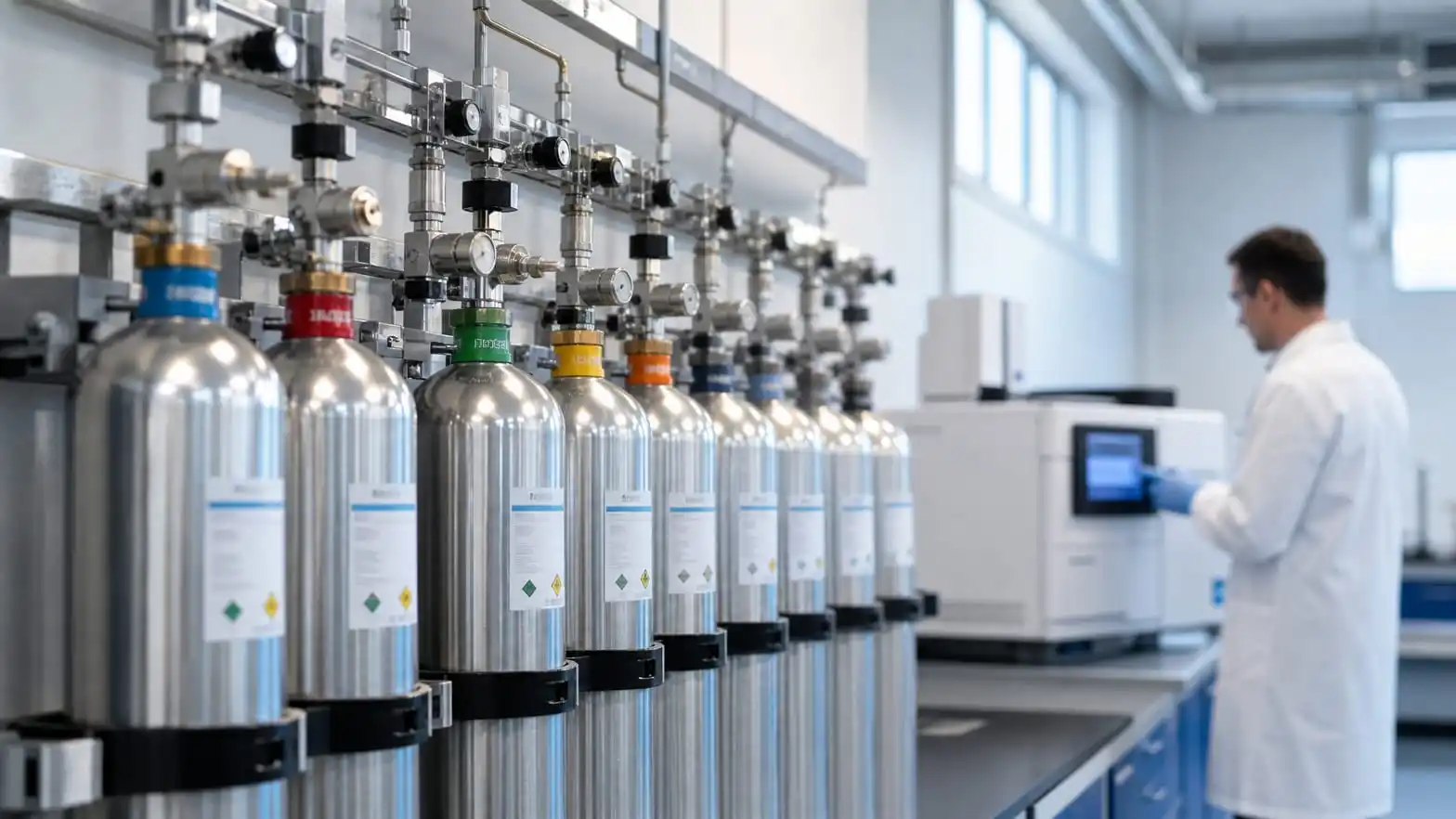
The four steps, in detail
1. Require a per-lot CoA with impurity detail
For the specific lot you received, the certificate should show the major component concentration, and then — this is the part most quotes omit — each specified impurity on its own line: O₂, H₂O, N₂, CO, CO₂, hydrocarbons. It should name the analytical method and the detection limit for each, and carry the measurement date and instrument.
Why this matters: a gas that “meets 5N” on the major component can still be 8 ppm in moisture if nobody bothered to print the H₂O line. The impurity breakdown is what you’re actually buying.
2. Write down what your process tolerates before you negotiate
A rough reference, from the specs we see most often:
| Application | Typical minimum | Reason |
|---|---|---|
| Calibration base gas (ppm–ppb blends) | 4N–5N | Base impurities must sit far below the analyte you’re calibrating against |
| Display / lighting fill (Ne, Kr, Xe) | 4N | Cost-sensitive, and 4N is the industry norm here |
| Excimer laser mixtures (KrF, ArF) | 5N components | Moisture and particulates damage cavities and optics |
| Semiconductor fab process gas | 5N–6N | Etch chemistry is intolerant of ppm-level cross-contamination |
| Research, isotope work | per protocol | Usually 5N+ with isotope ratio specified |
If a supplier can’t discuss what impurity budget your application has, they’re selling a cylinder. If they start asking about your downstream process, they’re selling a specification.
3. Audit who’s doing the measuring
A few questions separate a real lab from a mailing address: Do they test in-house, and if so, what’s the GC’s detection limit for the impurities you care about? What reference gases do they calibrate the GC with, and where did those reference gases come from? Is there ISO 9001 in place, and does the certificate scope actually cover production and filling — some certificates cover “trading” only, which tells you a lot. How are cylinders serialized, and can you trace a CoA back to a specific cylinder number? And for 5N and above, are the cylinders passivated or baked, with the valve conditioning done for the gas family?
That last one is worth a sentence on its own. We apply dedicated coating and passivation treatment to our laser-gas cylinders, and it’s not vanity: an unpassivated surface sheds moisture and oxide particles for the life of the fill. Ask any supplier to describe their passivation process per batch. Vague answers are the tell.
4. Make consistency contractual
The failure mode that catches most buyers isn’t lot one — it’s lot five drifting. The specification in the purchase agreement should read like this: per-lot impurity limits, written out (“O₂ ≤ 2 ppm, H₂O ≤ 1 ppm, N₂ ≤ 20 ppm” for a 5N xenon order, not “99.999% ± something”), CoA delivered with every shipment, a rejection process where the supplier pays for retest and replacement, and a right to run annual or per-qualification witness tests at an independent lab, with results shared both ways.
Batch consistency is a manufacturing capability, not a paperwork one. It comes from stable raw gas sourcing, controlled purification and fill-line discipline. Which is why a supplier’s production history is a legitimate diligence question — we’ve been supplying raw Ne, He, Kr and Xe to large state-owned gas enterprises in China for over two decades before we built our own product lines, and customers ask for that documentation. You should too.
Seven questions to put to any supplier
- Can you give me a per-lot CoA with O₂, H₂O, N₂, CO and hydrocarbons on separate lines?
- What’s your GC’s detection limit for the impurities my process cares about?
- Do you test in-house, and against which calibration standards — with their own traceability?
- What are the contractual impurity limits per lot, and what happens when one is missed?
- Are cylinders passivated or baked for 5N and above? How do you keep gas families from cross-contaminating on the fill line?
- Show me your ISO 9001 certificate — and what’s actually in the scope.
- Which independent labs do you allow for witness testing?
Three or more “we guarantee quality” answers and you have your decision.
FAQ
What’s the practical difference between 99.99% and 99.999%?
One order of magnitude in residual impurities: roughly 10 ppm versus roughly 1 ppm. For industrial and calibration-base work, 4N is usually enough and cheaper. For electronic and laser work, the impurities that survive at 4N — moisture, oxygen, particles — are exactly what causes failures, so 5N is the effective floor.
How do you measure gas purity in the first place?
Gas chromatography, with detectors chosen per impurity: TCD for the permanent gases (O₂, N₂, CO), PID or FID for hydrocarbons, MS for trace work, plus a dedicated humidity measurement for H₂O. If a CoA says “internal GC” without naming methods and detection limits, it’s not an answer yet.
What certifications should I expect before placing an order?
ISO 9001 with a scope covering production and filling is the baseline. Stronger signals are ISO 14001 or 45001, documented traceability to national metrology standards, and a lab that calibrates against reference gases with published uncertainty. The International Organization for Standardization publishes the underlying standards — check the scope line on the certificate, not just that it exists.
Is higher purity always better?
No, and it’s a common budget leak. Higher grades cost more, usually ship in smaller standard cylinder sizes, and get made in lower volumes, which means longer lead times. Buy the grade your process requires.
How do you lock in batch-to-batch consistency?
Per-lot impurity limits in the contract, per-lot CoAs, one independent witness test during qualification, and a written rejection process. Then track lot statistics over a few months — a capable supplier shows tight distributions, not merely passing lots.
Which impurities matter most for noble gases?
Oxygen, moisture, nitrogen, hydrocarbons. The first two drive material degradation in optics and semiconductor processes; the other two shift optical properties in lighting and display fills. Your CoA should report all four families.
Can I verify purity myself after import?
Yes. Send a sample to an independent ISO/IEC 17025-accredited lab — or your country’s metrology institute — for a witness test. It’s also how you build the relationship data that makes every future audit faster.
Where this leaves you
Purity verification is four steps: per-lot CoA with impurity detail, grade matched to the application, a real audit of the lab, and contractual batch consistency. Do all four and the number on the label stops being a claim and becomes a specification you can enforce. That’s the whole game.
Sources
- ISO — ISO 9001 and ISO/IEC 17025: iso.org
- SEMI — electronic gas industry standards: semi.org
- NIST — measurement standards and reference methods: nist.gov
- OSHA — 29 CFR 1910.1200, Hazard Communication: osha.gov
- UNECE — UN Model Regulations: unece.or
Post time: Oct-27-2026