
Xenon-129 Gas for NMR and Hyperpolarized MRI: What to Specify Before You Buy It
Xenon-129 is bought by enrichment, not purity grade: 99.9 atom% 129Xe (CAS 13965-99-6) is the line that sets the price. Purity is a second certificate. Everything else — cylinder volume, valve, return terms — follows from how you actually use the gas: as an NMR probe on a sample in a spectrometer, or as the feedstock you feed into a hyperpolarizer for lung imaging.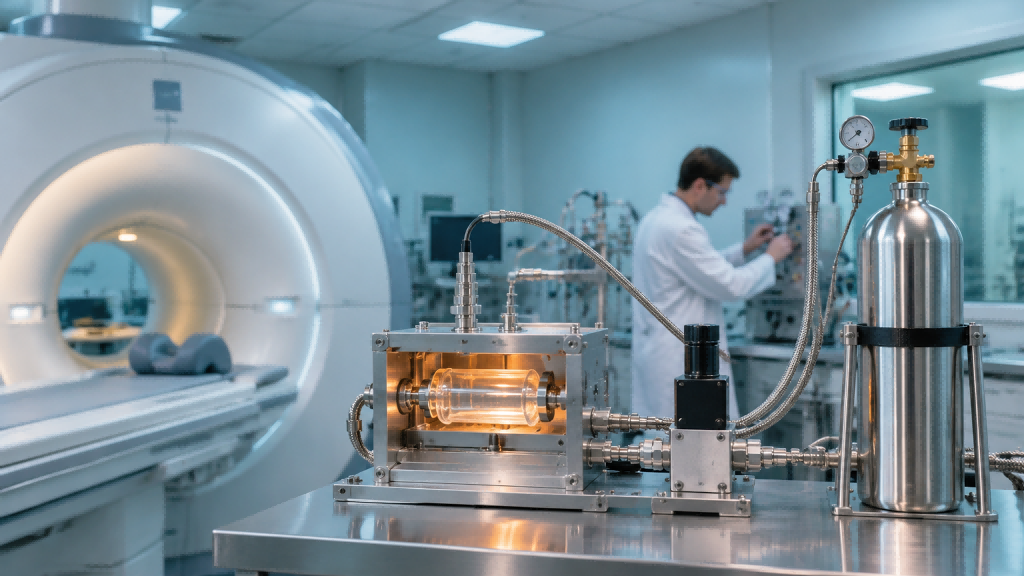
Those are two different purchases, and mixing them up is the most expensive mistake we see on requisition forms. A lab that orders 20 L of 99.9 atom% material for a handful of zeolite experiments is paying for gas it will never finish. An imaging center that orders the same 20 L believing it covers a clinical schedule is usually wrong by an order of magnitude.
Key takeaways
- Enrichment (atom%) and chemical purity (ppm impurities) are two separate specs on two separate certificates. Ask for both.
- Xe-129 is the only stable xenon isotope with nuclear spin 1/2 and zero electric quadrupole moment — that combination is why its hyperpolarized state survives long enough to image with.
- Natural xenon contains only 26.4% Xe-129. Enrichment to 99.9 atom% is a separation step, and that step, not the xenon itself, is most of the cost.
- Package sizes run from 0.3 L to 20 L for a reason: enriched isotope is metered, not bulked.
- Return and re-enrichment terms are a commercial spec. Put them on the purchase order, not in a later email.
What goes on the requisition — six fields
- Isotope and enrichment: 129Xe, 99.9 atom% minimum, stated as atom% (not “high purity”, not “research grade”).
- CAS: 13965-99-6. Natural-element xenon is 7440-63-3; if a certificate carries only that number, it is not an isotope analysis.
- Chemical impurity limits with detection limits: O₂, N₂, H₂O, CO/CO₂, hydrocarbons — each with a number and a method (GC-TCD/FID), not a bare “99.999%”.
- Quantity and package: 0.3 L / 0.5 L / 1 L small packages, or 5 L / 10 L / 20 L cylinders, at a stated fill pressure.
- Valve and fittings: G5/8 or CGA580 on the xenon family; state which, because a wrong thread costs a week of customs and adapters.
- Recovery terms: whether residual gas comes back, who analyzes it, and what credit applies.
Why xenon-129, and not just xenon
Xenon has nine stable isotopes. Only two of them are NMR-active, and only one of them is useful for imaging.
| Isotope | Natural abundance | Nuclear spin I | Why it matters |
|---|---|---|---|
| Xe-129 | 26.4% | 1/2 | Zero electric quadrupole moment, so the hyperpolarized state persists — seconds in blood, hours as a gas, days in a deep-frozen solid. This is the imaging and porous-material NMR isotope. |
| Xe-131 | 21.2% | 3/2 | NMR-active but quadrupolar; used in studies and, as the isomer Xe-131m, in nuclear medicine imaging. |
| Xe-124 | 0.095% | 0 | Target material for producing I-123 (diagnostic imaging) and I-125 (prostate cancer therapy). |
| Xe-136 | 8.86% | 0 | Detection medium for neutrinoless double-beta-decay experiments; also a neutron absorber for reactor xenon control. |
| Xe-130 | 4.07% | 0 | Dark-matter and neutrino detector media. |
| Xe-132 / 134 / 128 / 126 | 26.9 / 10.4 / 1.91 / 0.089% | 0 | No NMR signal. Xe-134 shows up in environmental and nuclear-activity tracing. |
Two consequences for a buyer. First, if you need signal, natural xenon is the wrong product — 26.4% is not a purity you can negotiate around. Second, Xe-129 at 11.8 MHz/T gyromagnetic ratio gives a weaker signal than the old helium-3 did, which is precisely why polarization quality and quantity discipline matter more than the headline number on the cylinder.
Two products wearing the same name
| Xe-129 as an NMR probe | Xe-129 as hyperpolarizer feedstock | |
|---|---|---|
| What you measure | Chemical shift and line shape of xenon adsorbed in zeolites, mesoporous silica, catalysts, polymers | Ventilation, gas exchange and barrier exchange in lung imaging |
| Typical quantity | Grams to a few litres, over months | Litres per session, consumed continuously |
| What ruins the experiment | Pore-wall interaction artifacts; oxygen and moisture in the sample loop | Short T1 from O₂, H₂O and hydrocarbon contamination; low abundance |
| Enrichment that makes sense | 80–99.9 atom%, depending on sensitivity needed | 99.9 atom% — spin-exchange optical pumping is an isotope-efficiency business |
| Package that fits | 0.3 L / 0.5 L / 1 L | 5 L / 10 L / 20 L, with recovery |
A materials-science group buying for Xe NMR on catalysts and a clinical or preclinical imaging group buying for hyperpolarized MRI should not be quoting the same product. Say which one you are.
Read the isotope certificate before the purity certificate
“99.999%” tells you almost nothing about an enriched isotope. The two numbers answer different questions:
- atom% 129Xe — isotope composition, measured by mass spectrometry. 99.9 atom% means about 999 of every 1,000 xenon atoms are Xe-129.
- chemical purity — what else is in the cylinder, measured by gas chromatography with stated detection limits.
A cylinder can be 99.99 atom% 129Xe and still be unfit for spin-exchange optical pumping if it carries several ppm of oxygen or moisture, because those quench the polarization you are paying to create. We send both documents with enriched isotope shipments. If a supplier offers one, ask which of the two they skipped and why. Our general framework for reading certificates is in the purity verification guide.
One labelling quirk to expect: enriched isotopes frequently do not carry their own CAS number. On our xenon isotope product page Xe-131 is listed under the natural-element CAS 7440-63-3 while Xe-129 carries 13965-99-6. That is normal practice. The atom% column is the spec; the CAS column is a reference.
The impurities that actually cost you money
- Oxygen — the classic polarization killer in spin-exchange optical pumping. Specify low-ppm or better, and read the detection limit the supplier reported alongside the number.
- Moisture — hydrolyses nothing here, but it plates optics, shifts zeolite adsorption behavior, and freezes in transfer lines at cryogenic temperatures.
- Hydrocarbons — from contaminated lines or valve grease; they carbonize on hot polarizer cells.
- N₂ balance errors — nitrogen is deliberately added in the polarizer at a controlled ratio. Nitrogen that arrived by accident is a different problem from nitrogen you chose.
Ask for the per-lot chromatogram, not just the summary row. That single request sorts suppliers faster than any certificate on a wall.
Quantity: the arithmetic that belongs on the purchase order
Nobody can tell you your Xe-129 consumption from a catalogue, because it is a function of your polarizer and your schedule. Run it yourself, in this order:
- Volume per session from the polarizer manufacturer’s own batch figure — litres of xenon per polarization run, at the pressure the cell is filled to.
- Sessions per month at your real schedule, including the sessions you lose to a failed polarization run. Budget at least one lost run in five until you know your own rate.
- Polarizer recovery efficiency — how much xenon comes back out of the exhaust and the patient circuit. This is the single biggest lever on your annual spend, and it is an equipment spec, not a gas spec.
- Losses: transfer lines left standing, traps, cylinder residuals that stay behind at end-of-pressure.
- Safety margin for the first year: an extra cylinder, because lead time on enriched isotope is not a lead time on commodity xenon.
Then buy the small package first. A 1 L cylinder that turns out to be the wrong fit is an inconvenience; a 20 L one is a five-figure lesson.
Return, recovery and re-enrichment
Enriched xenon is a circular product in practice. Residual gas from a used cylinder, a sample loop or an exhausted imaging session is still mostly 129Xe — it is contaminated, not consumed. Suppliers with an isotope separation capability can take it back, analyze it, re-purify and re-enrich it, and credit you against the next purchase.
Get three things in writing before the first order: who performs the residual analysis (100% analysis, not a grab sample), what contamination invalidates a return, and how credit is calculated. Note that this is also a contamination-control question — see the import and shipping checklist for the paperwork side of moving returned cylinders across borders.
Research grade is not the same as human-use grade
Stable Xe-129 is chemically inert, non-toxic and non-flammable — transport class 2.2, UN2036 — and the main hazard is oxygen displacement in a closed room. That is the easy half.
The hard half is documentation. If the gas will be inhaled by a person, the question is not “is xenon safe” (it has been used as an anaesthetic) but “what grade am I buying, and what documentation supports that grade”. Ask the supplier directly which grade you are being quoted, what the container history is, what the impurity spec is, and whether they can support the regulatory pathway your institution is working under. If the answer is a data sheet for industrial gas, you are in the wrong conversation — and, at that point, walk away rather than paper over it later.
The other xenon isotopes on the same page
We list these together because the same separation work produces them, and buyers of one are often three months from needing another.
| Product | Enrichment / purity | CAS | Typical use |
|---|---|---|---|
| Xenon-124Xe | 99.5 atom% | 15687-60-2 | I-123 / I-125 production; Ba-128 target |
| Xenon-129Xe | 99.9 atom% | 13965-99-6 | NMR spectroscopy; hyperpolarized MRI |
| Xenon-131Xe | 99.9 atom% | 7440-63-3 (element CAS) | NMR studies; Xe-131m for imaging |
| Xenon-136Xe | 99 atom% | 15751-79-8 | Double-beta-decay detectors; reactor xenon control |
| Xenon difluoride XeF₂ | 99.999%, solid, 10 g / 100 g / 500 g | 13709-36-9 | Plasma-free isotropic silicon etching; mild fluorinating agent |
XeF₂ is the odd one out — a colorless crystalline solid, not a compressed gas, and it decomposes on contact with moisture to release corrosive HF. Store it dry and away from water, and do not treat it as “just another xenon product” on a customs declaration. Our other enriched isotopes — carbon-13, oxygen-18, nitrogen-15, helium-3 — follow the same small-package, analysis-first logic.
Qualifying a Xe-129 supplier, five steps
- Ask for the mass-spec isotope report for the actual lot, and the GC impurity chromatogram. Both, per lot.
- Ask who separates the isotope. A trader with a resale arrangement and a producer with a separation line respond differently to this question, and both answers are acceptable — you just need to know which one you are buying.
- Ask for the container history: new or re-used cylinder, internal treatment, valve type, prior contents.
- Buy a 0.3–1 L package first and test it in your own system before committing to a 20 L cylinder.
- Write recovery, analysis and credit terms into the purchase order.
What we are, and what we are not
Disclosure, since we are one of the suppliers a buyer might be comparing. Hubei Newradar Electronic Gas Co., Ltd. lists 99.9 atom% Xe-129 in 5 L, 10 L and 20 L cylinders with 0.3 L, 0.5 L and 1 L small packages, alongside Xe-124, Xe-131, Xe-136 and XeF₂, and we ship xenon isotope gas internationally out of Hubei, where we have handled hazardous gas export since 2007 and excimer and isotope mixtures since 2011. What we do not claim: we are not a global bulk-xenon producer, we are not the cheapest route to commodity 5N xenon, and we do not publish a pharma-grade DMF for clinical xenon. If your program needs those, ask us anyway — we will say so in the first reply rather than in the third.
Frequently asked questions
Where can I buy xenon-129 gas for NMR spectroscopy?
From isotope producers and from specialty-gas companies that run enrichment. Specify 99.9 atom% 129Xe, request the lot’s mass-spec isotope report plus the GC impurity report, and start with a 0.3–1 L package before committing to 5–20 L.
Is Xe-129 the same thing as 5N xenon gas?
No. 5N (99.999%) is a chemical purity figure for natural xenon. Xe-129 is an isotope-enriched product quoted in atom%. You can buy 6N natural xenon that contains only 26.4% Xe-129 and will not give you the signal you are planning an experiment around.
What does 99.9 atom% mean?
About 999 of every 1,000 xenon atoms in the cylinder are Xe-129. Enrichment is what separates an isotope product from a purified one, and it is the cost driver.
Why does hyperpolarized MRI need enriched xenon at all?
Because spin-exchange optical pumping works on the Xe-129 nuclei. At natural abundance, most of the atoms in your expensive batch of gas are inert to the process, and the ones that do polarize are diluted by the ones that do not.
How much xenon-129 does a hyperpolarizer consume?
It is set by your polarizer’s batch volume, your session count, your failed-run rate and — above all — your recovery efficiency. Do the five-step arithmetic above against your own equipment documentation; anyone quoting a universal litres-per-scan figure is guessing.
Can unused or residual xenon-129 be returned?
Usually yes, and it should be. Residual enriched xenon is contaminated rather than consumed, and a supplier with separation capability can re-purify and re-enrich it. Put the analysis, contamination limits and credit terms on the purchase order.
How is xenon-129 shipped and stored?
As a compressed inert gas: UN2036, hazard class 2.2. Upright, secured, ventilated, away from heat. The real risk is asphyxiation by oxygen displacement in a closed space, not toxicity or fire.
Xe-129 or Xe-131 for my NMR work?
Xe-129, unless you have a specific reason not to. Spin 1/2 with no quadrupole moment gives the long-lived state and the cleaner line. Xe-131 (spin 3/2) is used in dedicated studies.
Do the isotope and the natural-element CAS numbers have to match?
Not necessarily. Many enriched isotopes have no dedicated CAS and are listed under the parent element. Xe-129 does carry its own (13965-99-6). Trust the atom% column, not the CAS column.
Disclosure: Newradar Gas wrote this article and is one of the xenon-129 suppliers a reader of it might contact. Product specifications quoted here are taken from our own published product page; the isotope physics is referenced to the sources listed below.
Sources
- Microporous and Mesoporous Materials — 129Xe NMR: review of recent insights into porous materials: https://www.sciencedirect.com/science/article/abs/pii/S1387181115006307
- MDPI Applied Sciences — 129Xe: A Wide-Ranging NMR Probe for Multiscale Structures: https://www.mdpi.com/2076-3417/12/6/3152
- PMC — Hyperpolarized Xenon-129 MRI: Narrative Review of Clinical Studies: https://pmc.ncbi.nlm.nih.gov/articles/PMC11854573/
- RSNA — Hyperpolarized MRI Improves Lung Disease Classification: https://www.rsna.org/news/2022/july/hyperpolarized-mri-lung-disease
- PMC — Technologies and Strategies for Metabolic and Molecular MRI (129Xe gyromagnetic ratio): https://pmc.ncbi.nlm.nih.gov/articles/PMC12810999/
- United Nations — Model Regulations on the Transport of Dangerous Goods: https://unece.org
- Newradar Gas — Xenon Isotope product page (specification and package data): https://www.nrdgas.com/xe-isotope-xenon-isotope-gas-product/
Post time: Nov-27-2026